From Idea to Product/Market Fit
A stage map for early founders
Find the stage your venture is in, see what finishes it, and come back every 90 days. Each stage tells you how it feels, what done looks like, what matters most, and what to change when you stall.
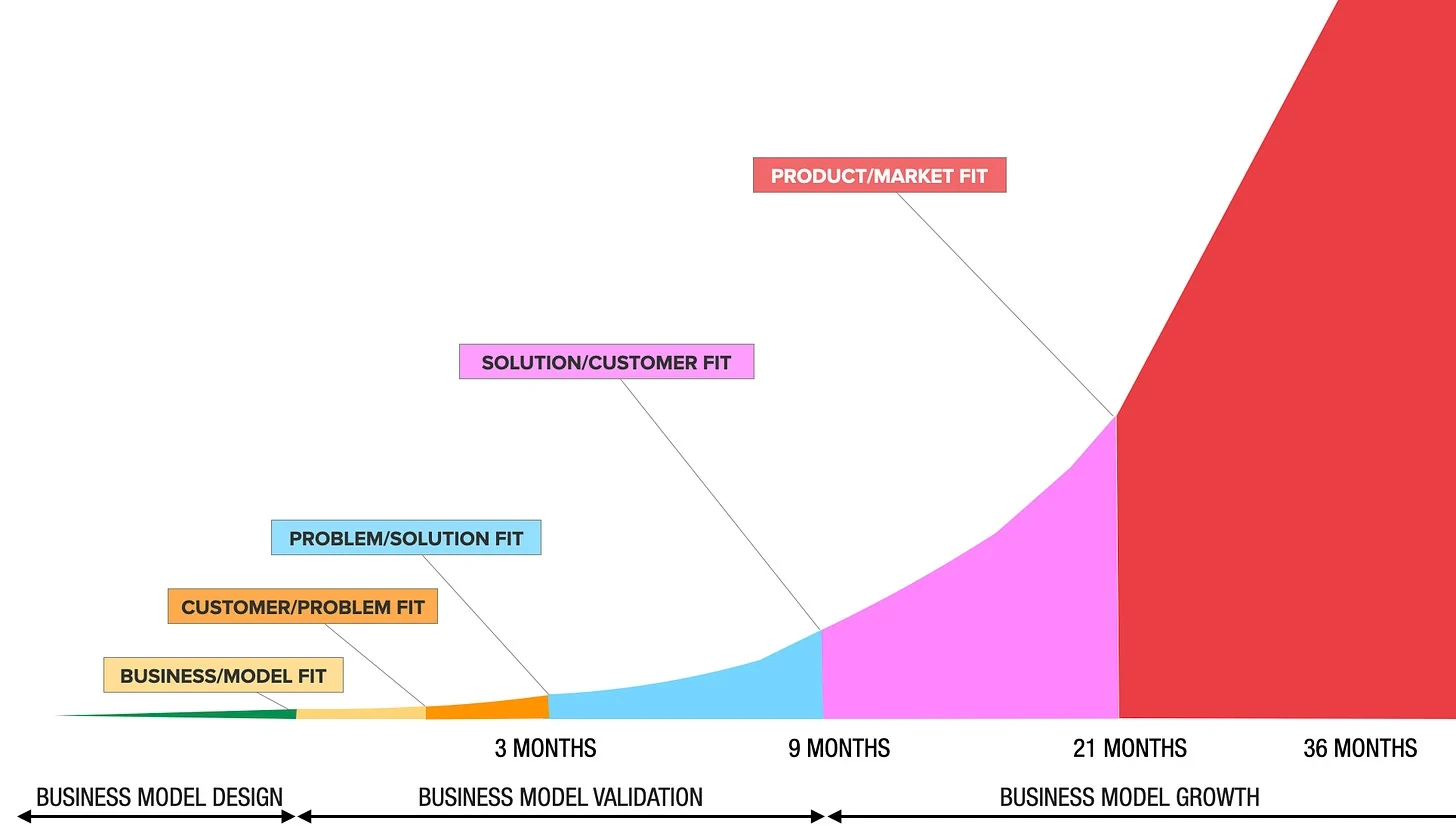
The five stages
| Stage | The job | Done when |
|---|---|---|
| Stage 1Take the idea apart | Put the idea on one page and find the assumption most likely to sink it. | The whole idea fits on one page, from who it serves to how it gets paid. |
| Stage 2Prove someone wants it | Get early adopters to pay or sign before you build. | Early adopters repeatedly switch to you from what they use today. |
| Stage 3Launch to your best early adopters | Deliver a first version to a small, hand-picked batch and learn from it. | A hand-picked first batch of early adopters is using your first version. |
| Stage 4Make happy customers who stay | Get early customers to the result they came for, and keep them coming back. | Early customers get the result you promised them. |
| Stage 5Find the growth loop | Find one repeatable way for customers to bring you customers, and make it pay. | New customers come from what past customers give back: money, content or referrals. |
On average a product takes about two years to reach product/market fit, and 80% never get there.1
Ask every 90 days
Are customers doing more of what pays you than they were 90 days ago? Then decide: keep going, change course, or stop.1
Five levers to pull when you stall
- ProblemAre you solving the smallest problem that makes people switch and still makes the business work?1
- PromiseIs your promise different, easy to grasp, and specific enough to check within weeks?1
- PriceIs the price fair against what people use today, and does it make the numbers work?1
- PeopleAre you selling to the people most eager to switch, who you can reach, and who already spend time or money on the problem?1
- PackagingCan you build and launch it quickly, in a form that makes people switch?1
The case studies are well-known companies' own accounts, taken from public founder interviews and company posts; the footnotes point to them.
Stage 1 of 5
Take the idea apart
Put the idea on one page and find the assumption most likely to sink it.
What it feels like
You can talk about the idea for ten minutes but cannot yet fit it on one page. Everything feels important and nothing has been tested. Friends say they like it. That feels like progress. It is not.
Case study
Perplexity
Perplexity's founders wanted to take on Google. The first idea its CEO pitched was asking questions about whatever you see through a pair of glasses. Told to find a narrow edge first, they built search over Twitter data, where a model turned a plain question into a database query. People liked the demo, but it depended on access to Twitter's data, which was about to be cut back. On 7 December 2022 they released a general web search that answers with its sources. People kept using it over the Christmas holidays, so that became the focus.2
Benchmarks
Done when
- The whole idea fits on one page, from who it serves to how it gets paid.1
- You have ranked your assumptions and can name the one that would sink the idea first.1
- A rough estimate shows the idea can reach the smallest result you would call a success.1
- You have a plan in stages that says what proof of demand looks like, and roughly when you expect it.1
What matters most
- Find the riskiest assumption, not the most interesting one.
- Decide the smallest result you would call a success, then check the idea can reach it.
Yellow flags
- Your page lists five kinds of customer and no early adopter.Lever: People. Pick the group that feels the problem most often and already spends money working around it.
- The estimate only works if nearly everyone buys.Lever: Price. Try a higher price, or a bigger purchase per customer, before you count on more customers.
- The solution takes a page to describe and the problem takes one vague line.Lever: Problem. Rewrite the problem as what breaks in the way people handle it today.
Stage 2 of 5
Prove someone wants it
Get early adopters to pay or sign before you build.
What it feels like
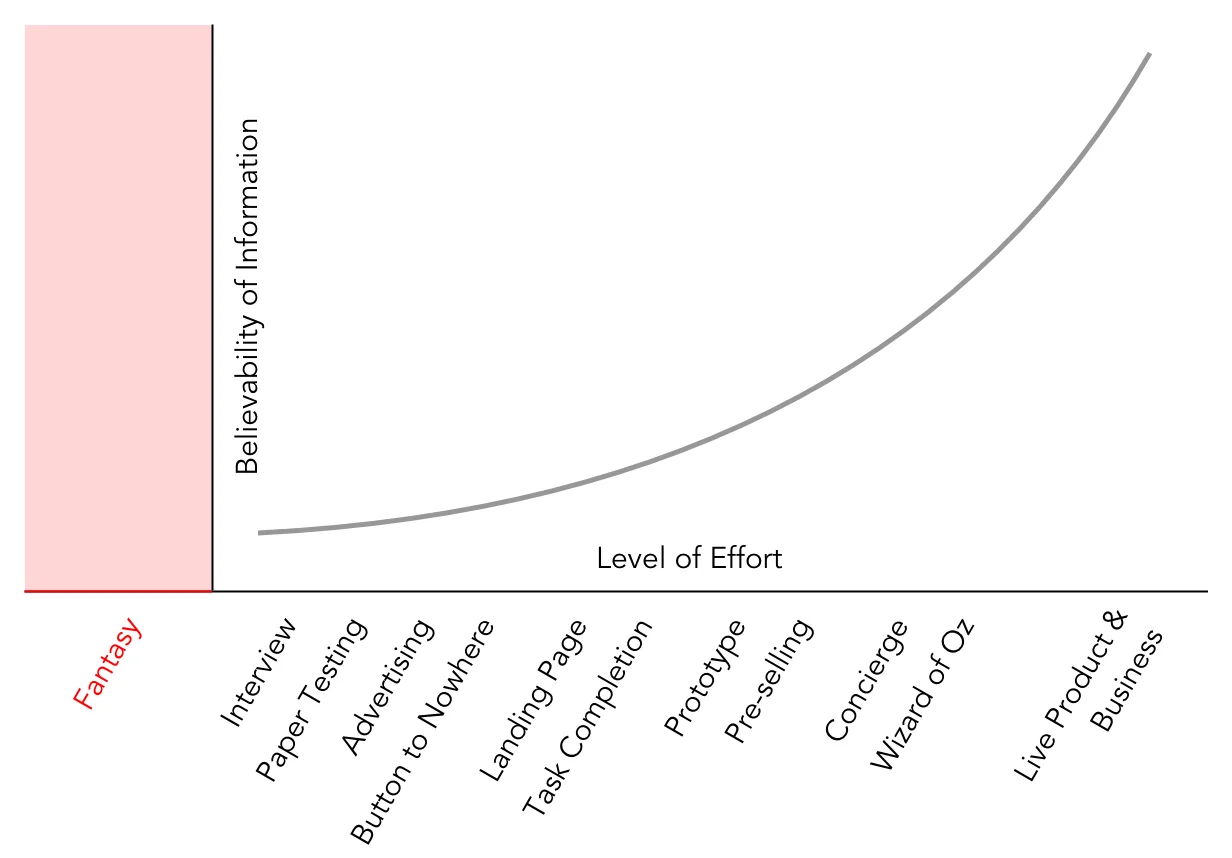
You are talking to a lot of people and hearing a lot of polite interest. Some conversations start to repeat almost word for word. That is a good sign. The hard moment is asking for money before the product exists.
Case study
Harvey
Before Harvey had a product, its founders tested whether lawyers would trust its answers. They wrote a long prompt over California landlord and tenant law, ran it on 100 questions from a Reddit legal advice forum, and gave the answers to three landlord and tenant lawyers without mentioning AI. The question was simple: would you edit this, or send it as is? On 86 of the 100, at least two of the three said they would send it with no edits. Then came the commitment. The law firm Allen & Overy tried Harvey in beta from November 2022. About 3,500 of its lawyers asked it around 40,000 questions in their client work, and in February 2023 it became the first law firm to partner with Harvey.34
Benchmarks
Done when
Typical time: Usually one or two 90-day cycles: three to six months.1
- A customer group usually has three to five main stories about the problem. When new interviews stop adding new ones, you have found them.1
- An offer built tightly around the problem you found typically turns 60% to 80% of qualified prospects into paying customers. One practitioner's observation, not a study.1
What matters most
- Ask for a commitment that costs the customer something: money, time or a signature.
- Measure what people do, not what they say about your idea.
Yellow flags
- Everyone says it is a great idea, and nobody pays or signs.Lever: Promise. Rewrite the promise around the result they told you they want, and ask again.
- Every interview turns up a different problem.Lever: People. Narrow to one group of early adopters until their stories repeat.
- Prospects agree with everything except the price.Lever: Price. Anchor the price to what the old way costs them today, not to your own costs.
- Each new yes needs one more thing added to the offer.Lever: Problem. Cut back to the smallest problem that made the first people switch.
Stage 3 of 5
Launch to your best early adopters
Deliver a first version to a small, hand-picked batch and learn from it.
What it feels like
Suddenly there is too much to build, and every customer wants something different. Launching to everyone at once is tempting, because the numbers look bigger.
Case study
Midjourney
In 2022 Midjourney had no app of its own. Its image generator ran inside Discord, an existing chat service. The founder's reason: people want to make things together, and a separate app would have meant building a social network from scratch. A new user got 25 free credits, every image was made in a public chat room, and after that it cost $10 or $30 a month. When The Verge interviewed him in August 2022, the company was about ten people.5
Benchmarks
Done when
Typical time: Aim to be ready to launch within one 90-day cycle.1
- Three months is usually long enough for a customer to decide whether to keep or drop any product. Build only what the first 90 days of use need.1
What matters most
- Set a launch date, tell your early adopters, and keep it.
- Launch in small batches, starting with the customers you most want to keep.
Yellow flags
- The launch date has moved twice.Lever: Packaging. Cut the first version down to what the first 90 days of use need.
- You plan to launch to your whole list at once.Lever: People. Hand-pick a first batch of your best-fit early adopters, then add the rest in batches.
- Feature requests are filling the plan.Lever: Problem. Keep only what serves the problem the first batch paid you to solve.
Stage 4 of 5
Make happy customers who stay
Get early customers to the result they came for, and keep them coming back.
What it feels like
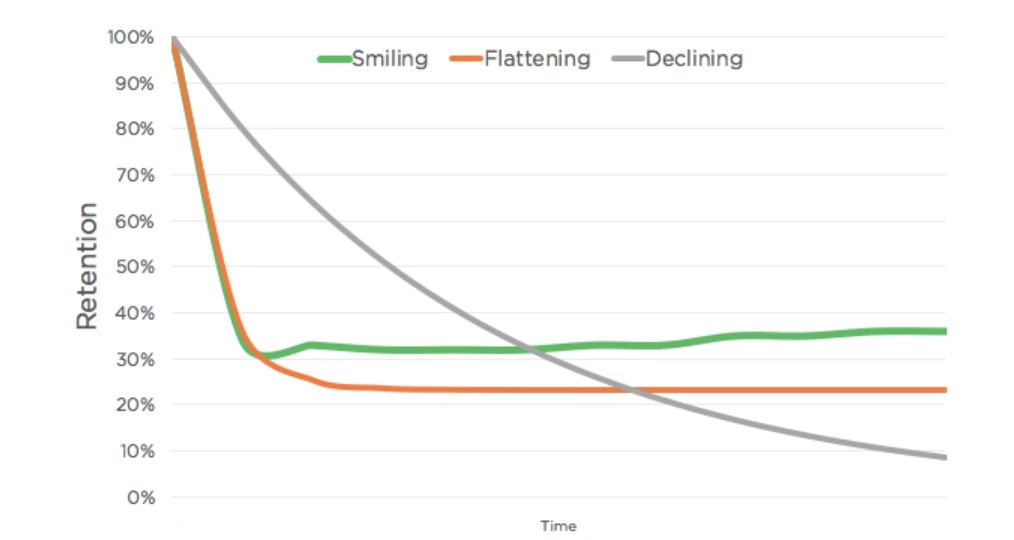
Customers signed up, and some have gone quiet. A sale turns out to be a beginning, not an end. You want to build new things; the things people already use need fixing.
Case study
Granola
Granola, an app that writes up your meeting notes, ran a closed beta for a year. It started with three users and grew to about a hundred people the team was building with. Its CEO says they built many features and cut them to find what was truly core. What stayed is simple: no bot joins your meeting, just something on your computer that looks like a notepad. He says 70% of people come back a week after installing it.6
Benchmarks
Done when
Typical time: Usually three to six months.1
- Right after launch, spend about 80% of your time measuring and improving what customers already use, not adding features.1
What matters most
- Find the moment a new customer first gets the result, and get every new customer there faster.
- Fix why customers leave before you go looking for more.
Yellow flags
- Customers sign up and never reach the result.Lever: Packaging. Remove steps between sign-up and the first result. Do them by hand for the customer if you must.
- Customers who got the result drift back to the old way.Lever: Promise. Compare the promise with what they actually got, and close that gap before adding anything.
- You are building new features to win back customers who left.Lever: Problem. Go back to the one problem they hired you for and make that work better.
Stage 5 of 5
Find the growth loop
Find one repeatable way for customers to bring you customers, and make it pay.
What it feels like
Early customers are happy, but every new one still takes your personal effort. Several channels half work. The business works, just not without you.
Case study
Cursor
Cursor, a code editor, did not grow through marketing. An early push on social media built a waitlist. After that, in the CEO's words, the team "lived like monks in 2023 and just focused on the product," and it "really just spread from word of mouth." They tried short sprints of growth work; the results were small next to what improving the product did. In January 2025 the company reported that millions of programmers used Cursor and that it had passed $100 million in recurring revenue.78
What matters most
- Pick one main growth loop and test it before running several at once.
- Check that what each customer is worth covers what it costs to win them.
Yellow flags
- Growth stops whenever you stop selling in person.Lever: People. Find which customers bring others, and aim your effort at people like them.
- Each new customer costs more to win than they pay you.Lever: Price. Raise the price, or what each customer buys, before you spend more on winning them.
- Happy customers rarely mention you to anyone.Lever: Promise. Make the result worth talking about, and ask for an introduction at the moment a customer gets it.